
Who Should NOT Be Posting on LinkedIn Every Day (Honest Truth)
May 26, 2026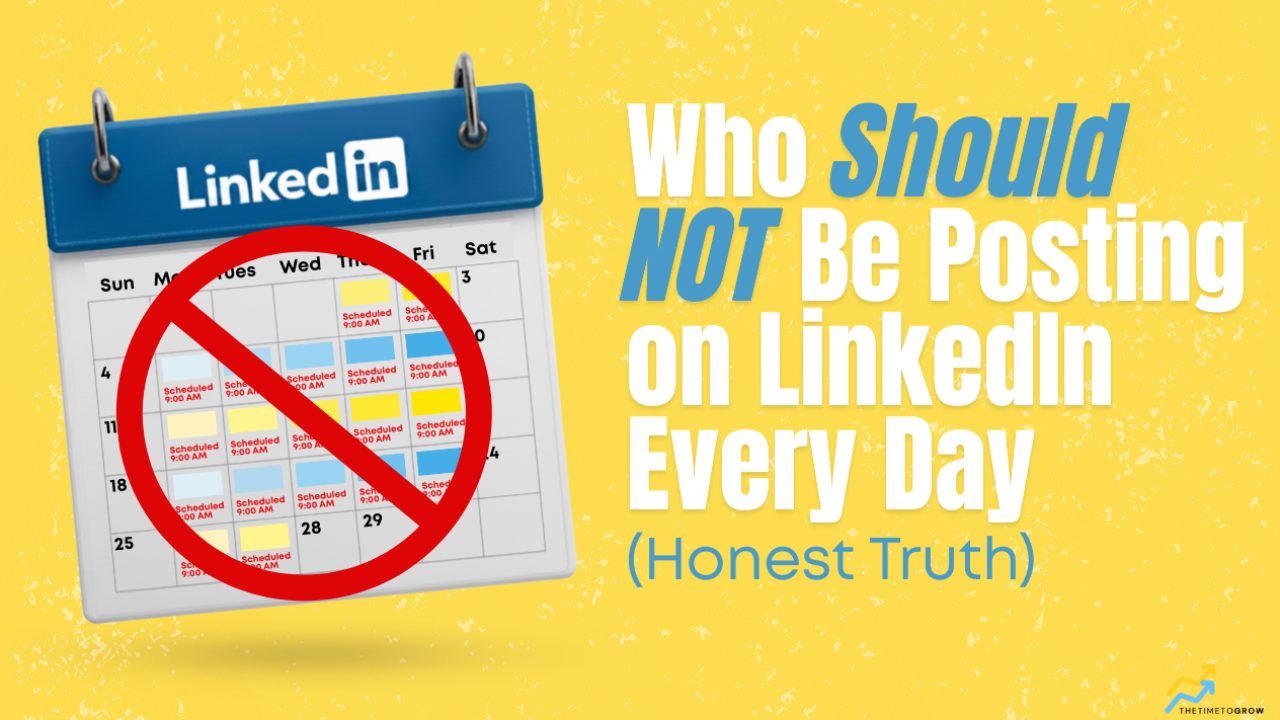
Let's get something out of the way right up front. If you have been grinding away at a daily LinkedIn posting strategy and wondering why your pipeline still feels empty... you are not broken, and you are not failing. You may just be playing the wrong game entirely.
The idea that you need to post on LinkedIn every single day to grow your business has become the loudest piece of advice in every marketing circle. And sure, consistency matters. But consistency without strategy is just noise.
In this post, we are breaking down who should actually reconsider daily LinkedIn posting, what a smarter approach looks like, and how to stop spinning your wheels and start seeing real results from the content you are already creating.
The "Post Every Day" Advice Isn't Wrong, It's Just Incomplete
LinkedIn rewards consistency. The algorithm does favor accounts that post regularly, and engagement tends to compound over time when you show up regularly. We are not here to tell you that posting frequency doesn't matter at all.
But here's what the gurus are leaving out: frequency without focus will tank your results faster than posting nothing at all.
A 2023 report from the Content Marketing Institute found that 44% of B2B marketers say producing content consistently is their biggest challenge, and yet the solution most often prescribed is "just post more." That's like telling someone who's exhausted to run faster.
The real question isn't how often you're posting. It's whether what you're posting is actually built to do anything for your business.
Who Should NOT Be Posting on LinkedIn Every Day
1. The Person Who's Posting Without a Clear Goal
If you cannot answer the question "what do I want someone to do after reading this post?" in one clear sentence, daily posting is working against you. You are training your audience to scroll past you, because they do not know what to expect or why it matters to them.
Posting without a strategy creates a noisy presence, not a trustworthy one. Before frequency, nail down your purpose.
Ask yourself:
-
Am I posting to generate leads, build brand awareness, or nurture existing relationships?
-
Does each post move someone closer to working with me?
-
Would my ideal client read this and think, "this person gets exactly what I'm dealing with"?
If the answer to any of those is "not really," slow down and get clear before you scale up.
2. The Person Who's Repurposing Without Relevance
Repurposing content is smart. It is one of the most efficient LinkedIn marketing strategies available, especially for busy business owners who already have a podcast, newsletter, or blog. But repurposing for the sake of hitting a daily quota? That creates volume with zero value.
LinkedIn users are professionals. They are scrolling during a coffee break, between meetings, or after a long client call. They are not looking for filler content. They are looking for something that makes them feel seen, informed, or inspired.
If your repurposed content isn't adapted to the LinkedIn audience specifically, it reads like a copy/paste job, and your audience will feel that instantly.
3. The Person Who's Already Stretched Too Thin
Here is a truth the hustle culture corner of LinkedIn won't tell you: posting daily from a depleted, resentful place produces content that sounds depleted and resentful. Readers can feel it.
If your current LinkedIn posting strategy is causing burnout, skipped weekends, or rushed, thoughtless content, three high-quality posts per week will outperform seven mediocre ones every single time.
Quality and intentionality are what build trust. Trust is what builds a client base.
4. The Person Chasing Vanity Metrics
Likes, impressions, and follower counts are exciting. They're also largely meaningless if they're not translating into actual conversations, leads, or clients.
If you've been measuring your LinkedIn success by reach alone, you may have been pouring time and energy into content that performs well on paper but does nothing for your bottom line.
A targeted LinkedIn posting strategy that speaks directly to your niche, even if it reaches a smaller audience, will always outperform broad content designed to go viral.
What a Smarter LinkedIn Posting Strategy Actually Looks Like
Now, here's where we flip the script. Because this isn't a post about giving up on LinkedIn. Far from it.
LinkedIn is genuinely one of the most powerful platforms for B2B lead generation, thought leadership, and building the kind of trust that turns followers into paying clients. But it requires a strategy built around impact, not just output.
Here are the core pillars of a LinkedIn posting strategy that actually works:
-
Post with intention, not obligation. Every post should have one job: educate, entertain, inspire, or convert. When you sit down to create content, start with the outcome in mind, not the calendar slot.
-
Focus on depth over breadth. One post that genuinely resonates with your ideal client is worth more than 10 posts that get polite nods. Speak to the specific problems, fears, and goals of the person you most want to attract.
-
Let your content do the heavy lifting. Your posts should work for you while you are in client calls, on vacation, or simply taking a breath. That means writing content that has a clear point of view, a clear takeaway, and a clear next step.
-
Use proven frameworks. You do not have to reinvent the wheel every time you sit down to write. Frameworks and templates built around what actually converts on LinkedIn can save you hours of blank-page frustration and produce better results.
The Posts That Actually Convert on LinkedIn
Not all LinkedIn content is created equal. The posts that consistently drive engagement, conversations, and conversions tend to fall into a few specific categories:
-
The Story Post: A personal, relatable moment that connects your experience to a lesson your audience needs to hear. These build trust fast.
-
The Perspective Post: A contrarian take or fresh angle on a common problem in your industry. These drive comments and shares.
-
The Value Post: Actionable, specific advice that your audience can take and implement immediately. These establish credibility.
-
The Conversion Post: A direct, confident post that highlights who you help, what you do, and how someone can take the next step. These generate leads.
A well-rounded LinkedIn posting strategy cycles through these formats regularly, so your audience always knows what you bring to the table and how you can help them.
The Bottom Line on Daily LinkedIn Posting
Here is what we want you to walk away with.
Daily posting on LinkedIn is not a strategy. It is a tactic. And tactics without strategy are just busyness dressed up as productivity.
If you are someone who has been showing up every single day and burning yourself out, give yourself permission to slow down and get intentional. Three powerful posts per week, built around your ideal client's real problems and your genuine point of view, will do more for your business than seven rushed ones.
And if you are someone who has been avoiding LinkedIn altogether because the "post every day" pressure felt impossible... this is your green light. You don't need to be everywhere. You need to be strategic.
LinkedIn is one of the most powerful tools available for growing a professional service business. But only when you use it with a plan.
Ready to Post Smarter?
A smart LinkedIn posting strategy isn't about volume. It's about value, consistency with intention, and content that's actually built to convert.
Stop measuring your success in posts per week. Start measuring it in conversations started, relationships built, and clients gained.
You've got something worth saying. Make sure the way you're saying it is actually working for you.
Grab our 3 High-Impact LinkedIn Post Templates and walk away with a clear, proven framework for creating content that actually moves the needle.
