
The 15 Minute LinkedIn Daily Routine That Beats Posting Every Day
Jul 21, 2026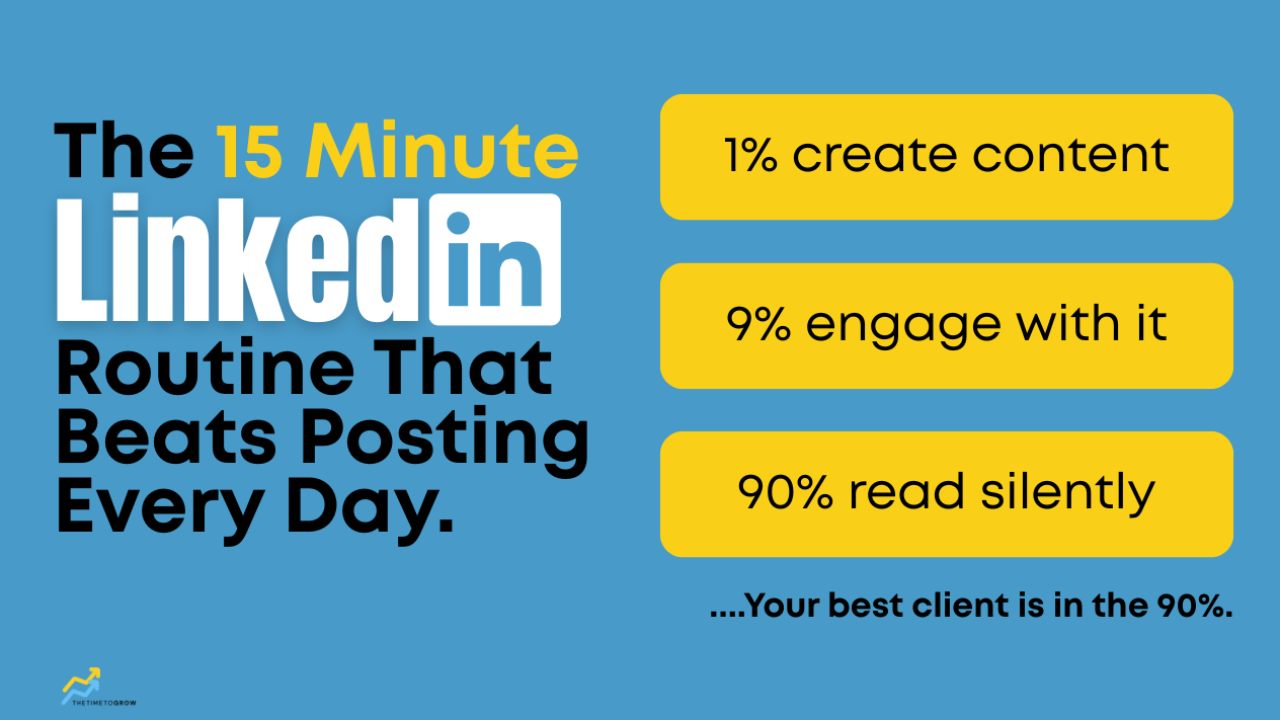
You've been told the secret to LinkedIn is simple. Just post more.
So you did. You wrote the post, hit publish, refreshed twice, and watched it collect four likes... three of which came from people you went to college with.
Here's what nobody mentions when they hand you that advice: a LinkedIn daily routine built entirely around publishing is a routine built around talking. And talking, all by itself, has never closed a piece of business.
The good news is that the fix takes about fifteen minutes. Not fifteen minutes of writing. Fifteen minutes of the quieter work that happens before, around, and after your content, the work that actually puts people in the room to read it.
In this post, we'll walk through why posting alone stalls out, what a real LinkedIn daily routine looks like broken into three five minute blocks, and how to make it stick on the weeks when your calendar is a disaster.
The LinkedIn Math Almost Nobody Talks About
Start with a number that reframes everything.
Somewhere under 3% of LinkedIn's members post content in a given week, and the share posting daily is likely closer to 1%. Only about 3% of members post more than once per week. (Connectsafely)
Read that again, because most people read it as good news and stop there. It is good news. If you post at all, you have already lapped the field.
But it also means something less flattering. The people you want as clients are almost certainly not posting. They are reading. Research from the Nielsen Norman Group gave us the 1-9-90 rule years ago: for every person creating content, roughly nine engage with it and ninety silently consume it. (EveryoneSocial)
So your ideal client is in the ninety.
They will not like your post. They will not comment. They will read it, form an opinion about you, and move on. If your entire LinkedIn daily routine consists of publishing and waiting for engagement, you are measuring the wrong nine percent and quietly concluding it isn't working.
It is working. You just can't see it yet.
What Posting Does, and What It Cannot Do
Posting is broadcasting. It is you, talking, into a feed that has no obligation to carry you anywhere.
And LinkedIn's feed is not a megaphone. It's a room. Your post reaches the people already standing in it, which is to say your existing connections and whoever the algorithm decides to test you on for the first hour. If that room is small, or full of people who aren't your buyers, a brilliant post changes nothing.
Consider what buyers actually do. Roughly 42% of B2B buyers say they look at a seller's LinkedIn profile before they reply to outreach or agree to a meeting. (Centric DXB) And 6sense research finds that buyers arrive at first contact having already completed about 61% of their buying journey.
They are researching you before you know they exist.
Which means the real job of a LinkedIn daily routine is twofold. Your content has to be worth finding. And something has to send people looking for it in the first place.
Posting handles the first. Only engagement handles the second.
The 15 Minute LinkedIn Daily Routine, Block by Block
Here's the structure. Three blocks, five minutes each. Set a timer, because the timer is the whole point. Without it, five minutes of commenting becomes forty minutes of scrolling and a vague feeling that you accomplished something.
Minutes 1 to 5: Show Up Where Your Clients Already Are
Open your feed and find three posts from people you genuinely want to know. Not your peers. Not the other consultants doing what you do. The people who could hire you, refer you, or put you on a stage.
Leave one real comment on each.
A real comment is not "Great post!" A real comment adds something the post didn't have. Ask the question the author skipped. Share the counterexample from your own work. Name the part that changed your mind.
This matters more than it used to. LinkedIn comments grew 37% year over year, and comments are now among the strongest signals the platform reads when deciding who else should see a piece of content. (Connectsafely)
Here's the quiet part. Your comment gets shown to the author's audience. If you comment thoughtfully on a post that reaches 10,000 people, you have effectively published to 10,000 people without writing a post. And unlike your post, this one arrives with an implied endorsement from someone they already follow.
Three comments. Five minutes. That's the block.
Minutes 6 to 10: Tend Your Own Threads
Go to your notifications and reply to every comment and message on your recent content.
Every single one. Even the ones that just say "So true." Especially those.
Two things happen. First, a reply is a comment, and comments feed reach. A post that keeps generating conversation four hours after publishing gets shown to more people than one that flatlined at minute thirty. Your replies are the fuel.
Second, and this is the one people miss: a reply is a door. Somebody took a public risk to engage with your thinking. That is the warmest moment they will ever be. If you let it sit unanswered for two days, the moment closes.
This is where conversations start. Not in your DMs, not in a pitch, but in the small back and forth under a post where somebody realizes you're a person who actually responds.
Minutes 11 to 15: Extend the Circle
Send three connection requests. Personalized, every time.
Where do you find them? You already did. They're in the block you just finished. The people who commented on your post. The people who commented alongside you on someone else's post. The person whose thinking you noticed in minutes one through five.
Skip the blank request. Skip the template. Two sentences will do:
-
Name the specific thing that brought you there ("Your comment on Sarah's post about pricing stuck with me...")
-
Say what you'd like ("...would love to stay connected and follow your work.")
No pitch. Not now, not in the follow up message, not for a while. You are not selling. You are widening the room your next post walks into.
This compounds faster than people expect. Members who actively post and engage build connections three to four times faster than passive users. (Connectsafely)
Why the LinkedIn Daily Routine Works When Posting Alone Doesn't
Because it inverts the order.
Most people post and hope somebody notices. The routine makes somebody notice, then gives them something to find.
There's a second reason, and it has to do with what buyers trust. Seventy four percent of B2B decision makers say thought leadership content is a more trustworthy way to judge a company's capability than its marketing materials.
Your last five posts persuade harder than your capabilities deck. But only if the right person is standing in front of them.
And the audience is worth the effort. Four out of five LinkedIn members influence business decisions inside their organizations, according to LinkedIn Marketing Solutions. (Connectsafely) The average member spends 14 minutes and 20 seconds per session. (Cognism)
They're there. They're paying attention. They're deciding about you.
Making the LinkedIn Daily Routine Survive a Bad Week
We're going to be honest about something. Fifteen minutes a day sounds effortless right up until Tuesday, when a client emergency eats your morning and the routine is the first thing to go.
Here's how to protect it:
-
Attach it to something that already happens. First coffee. The gap between calls. The five minutes after you close your laptop. A LinkedIn daily routine that lives in a calendar block gets moved. One that lives inside an existing habit doesn't.
-
Lower the bar on your worst day. Bad week? Do one block. Just the comments. One block beats zero, and the streak matters more than the volume.
-
Keep a running list of ten people. Ten names you'd like to know. Ten profiles to open. Decision fatigue is what kills these routines, not lack of time. Remove the decision.
-
Stop measuring in likes. Measure in conversations. Profile views. Replies. Ninety percent of your audience is silent, and the silent ones are the buyers.
-
Do it before you post, not after. Warm the room, then walk in.
The One Thing 15 Minutes Cannot Do
Fifteen minutes a day will get people to your profile. It will grow your network, lift your reach, and start conversations that didn't exist last month.
And then somebody clicks your name.
If what they find is a headline that reads like a job title and a feed that's been quiet since February, the routine has done its job and your content has failed to do its own. A warm audience with nothing to read is not a strategy. It's a missed opportunity with better traffic numbers.
That's the other half. The posts, the polls, the newsletters, the thing you say when they finally arrive. The routine fills the room. Your content is what happens once they're in it.
Fifteen minutes gets you an audience. What you do with that audience is where the clients come from.
Fifteen Minutes Is Enough. Start Tomorrow.
The advice to post every day isn't wrong. It's incomplete.
Here's what we covered:
-
Fewer than 3% of LinkedIn members post weekly, and roughly 90% of any audience reads without ever engaging. Your buyers are in the silent group.
-
Posting is broadcasting. It reaches the room you already have.
-
A 15 minute LinkedIn daily routine builds that room: five minutes commenting where your clients already are, five minutes replying to your own threads, five minutes sending personalized connection requests.
-
Comments carry you into other people's audiences. Replies extend the life of your posts. Connections widen the room your next post enters.
-
Buyers research you long before they contact you. Roughly 42% check your profile before they'll even reply.
-
The routine creates the traffic. Your content is what converts it.
You don't need to post more. You need fifteen minutes and something worth finding when they arrive.
🚀 Free 3-day LinkedIn workshop, July 27 to 29 at 12 PM EST. Learn to turn posts, polls, and newsletters into clients. Save your seat 👉 Clients on Command Workshop: Your LinkedIn Content Roadmap
