
How to Build a LinkedIn Content System That Runs Even on Your Busiest Week
Jul 28, 2026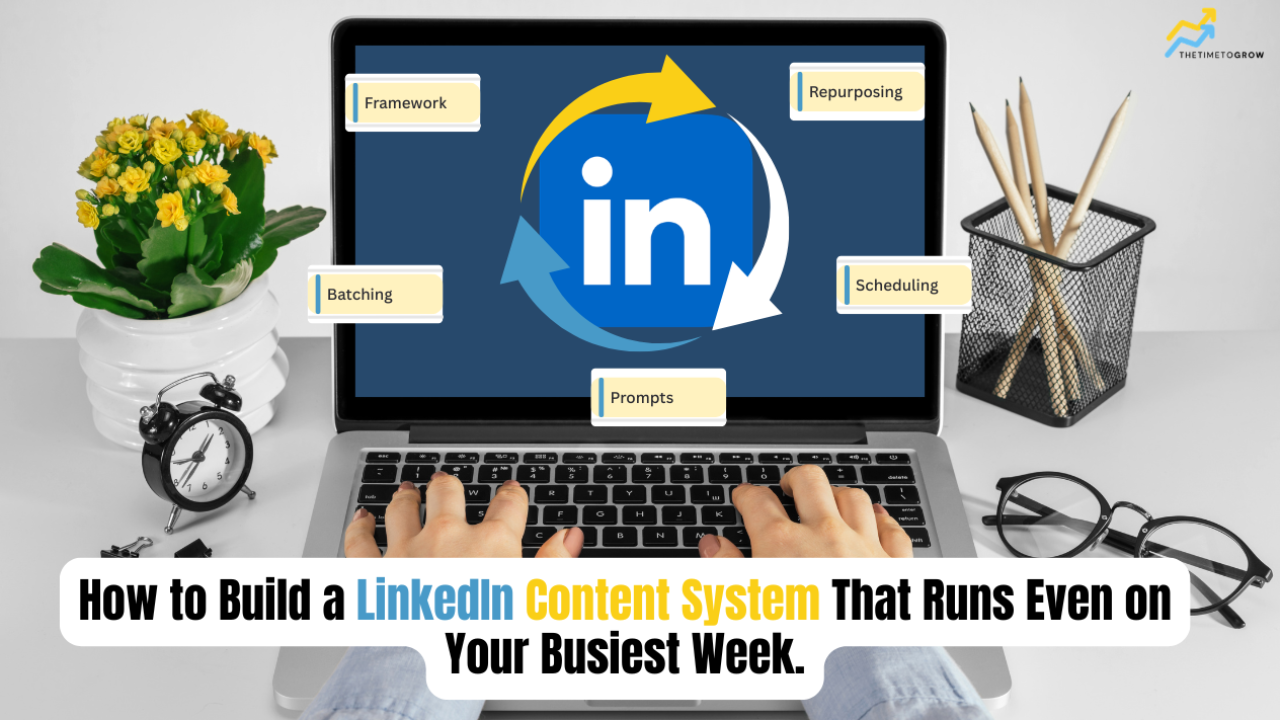
Picture your busiest week. Back to back calls, a client fire to put out, an inbox that refills faster than you can empty it. Somewhere in the middle of it, a small voice says, "you should probably post something on LinkedIn." And you don't. Again.
Here's the good news. Showing up consistently was never really about willpower or having a free afternoon. It's about having a LinkedIn content system that keeps running when you can't. A system does the remembering, the structuring, and the heavy lifting, so you don't have to summon motivation you simply do not have on a Thursday.
In this post, we'll cover what a content system actually is, why consistency beats raw talent on this platform, the five parts every reliable system needs, and a simple way to build yours in a single afternoon. By the end, "I forgot to post" stops being your story.
What a LinkedIn Content System Actually Is (and Why "Just Post More" Fails)
A LinkedIn content system is a repeatable process for deciding what to say, creating it in batches, and getting it scheduled, so your visibility no longer depends on how you feel on any given day.
Most advice skips straight to "post more" and "be consistent." That's not a plan. That's a wish. Telling a busy expert to be more consistent is like telling someone who's overwhelmed to "just relax." Helpful in theory, useless in the moment.
A system replaces motivation with structure. Instead of staring at a blank page every morning, you make a small number of decisions once, then let those decisions run for weeks. Think of it as the difference between cooking a fresh meal from scratch three times a day and doing a Sunday meal prep. Same outcome, a fraction of the daily effort.
Why Consistency Beats Talent on LinkedIn
Before we build the thing, it helps to know why the payoff is worth an afternoon of setup. The data on consistency is hard to argue with.
-
According to LinkedIn's own marketing guidance, brands that post weekly see 5.6x more followers and 7x faster growth than those that post less often. Rhythm compounds.
-
Buffer analyzed more than 2 million LinkedIn posts across 94,000+ accounts and found that moving from one post a week to two through five posts a week added roughly 1,182 more impressions per post. The platform rewards showing up rather than punishing it. (Source: Buffer, 2025.)
-
That same study found the lift held for small accounts and large ones alike. You do not need a big following for consistency to pay off... you need a steady cadence.
And this is not vanity engagement. It moves money. The 2025 Edelman-LinkedIn B2B Thought Leadership Impact Report, which surveyed 1,934 management-level professionals, found that 64% of decision-makers trust thought leadership content more than traditional marketing when they size up a potential partner. More than half (53%) said that when a company's thought leadership is strong, brand recognition matters less. In plain terms: steady, useful content lets a lesser-known expert out-position a bigger name.
The takeaway is freeing. You don't have to be the most brilliant voice in your niche. You have to be the one who reliably shows up. A LinkedIn content system is how the reliable ones do it without burning out.
The 5 Parts of a LinkedIn Content System That Runs Itself
Every system that survives a busy week has these five moving parts. Miss one and the whole thing gets wobbly.
1. A Simple Content Framework (Pick Your Pillars)
Decision fatigue is the silent killer of consistency. So take "what do I post about" off the table entirely by choosing three or four content pillars, the themes you'll rotate through on repeat.
For most coaches and consultants, a strong mix looks like:
-
Authority posts that teach something you know cold
-
Story posts that share a client win, a lesson, or a behind the scenes moment
-
Belief posts that stake out a point of view your ideal client nods along to
-
Invitation posts that gently point people toward working with you
When every idea has a home, the blank page problem mostly disappears. You're no longer inventing... you're filling slots.
2. A Batching Ritual (Create Once, Post All Week)
Writing one post at a time is the reason so many people quit. It's the "Monday panic, Thursday guilt" cycle, and it eats more hours than batching ever would.
Batching means you sit down once a week (or once a month) and create several posts in one focused block. You're already in the writing headspace, so post two flows into post three, which flows into post four. One study of B2B pages estimated that eight to twelve solid posts a month take only a few hours when produced in a sprint, versus the scattered, stressful mess of writing them one by one. Same output, far less drag.
3. A Prompt Library (Never Face a Blank Page)
Even with pillars chosen, "start writing" is a cold start. A prompt library warms up the engine for you. Instead of a blinking cursor, you get a specific, story-driven question that pulls the post out of you.
This is where good AI prompts earn their keep. The right prompt does not write generic filler in a robot voice. It asks you the right question, then helps you shape your own answer into something clear and worth reading. That combination, your real experience plus a prompt that draws it out, is what keeps your content sounding like you.
4. A Scheduling Home (Set It and Forget It)
A finished post sitting in a Google Doc helps no one. The system only works when creating and publishing are separated. You batch on your calm day, schedule everything, and then your busiest week takes care of itself because the work is already done.
One gentle guardrail from the data: aim for a sustainable cadence of two to five posts a week. Research consistently points to that range as the sweet spot for reach without wearing out your audience. Every post also has a short early window, roughly the first 60 to 90 minutes after publishing, when engagement signals decide how far it travels. Spacing posts out gives each one room to breathe.
5. A Repurposing Loop (One Idea, Five Formats)
Your best ideas deserve more than one outing. A repurposing loop turns a single insight into several posts across formats, which is a quiet cheat code for consistency.
Format matters here, because they don't perform equally. Buffer's analysis found that, compared to plain text posts, image posts earned about 72% more engagement, videos about 84% more, and carousels the clear winner with dramatically higher engagement and reach. So one strong idea can become a text post, a carousel, a poll, and a short video... four slots filled from one spark.
How to Build Your LinkedIn Content System in One Afternoon
You do not need a month of planning. You need a couple of focused hours. Here's the order of operations.
-
Choose your pillars. Write down three or four themes you could talk about for a year without running dry.
-
Draft your prompt library. Create two or three go-to prompts per pillar. A prompt is just a question that gets you talking, like "What's a mistake you see clients make constantly?"
-
Batch your first week. Set a timer for 90 minutes and write four posts. Do not edit as you go. Momentum first, polish second.
-
Load your scheduler. Drop those four posts into a scheduling tool and set the dates and times.
-
Add one repurpose. Take your favorite of the four and turn it into a second format. That's post number five, nearly free.
That's a working LinkedIn content system. Not perfect. Working. Perfect comes later, and only because you kept showing up long enough to learn what your audience loves.
How to Keep the System Running on Your Busiest Week
Building it is one thing. Protecting it when life gets loud is another. A few small habits keep the system alive:
-
Batch on your calmest day, not your busiest. Look at your week ahead and pick your lightest afternoon for content. Guard it like a client call.
-
Keep an "ideas parking lot." When a good thought hits you mid-shower or mid-meeting, drop it in one note on your phone. Your next batching session will thank you.
-
Lower the bar on hard weeks. Consistency beats intensity every time. Two thoughtful posts you actually publish beat five perfect ones stuck in drafts. It's far better to post eight times a month for two years than twenty times a month for six weeks and then vanish.
-
Write like a human, keep it scannable. AuthoredUp's research on nearly a million posts found that content written above a 10th grade reading level got over 35% less reach. Short paragraphs and plain words are not dumbing down... they're how busy people actually read.
What This Looks Like When It Works
Imagine it's your worst week of the quarter. A launch, a sick kid, a proposal due. You never once open LinkedIn to write.
And yet Monday morning, a text post goes out. Wednesday, your carousel lands and a dream client comments. Friday, your poll sparks a conversation that turns into a discovery call the following week.
None of it required you to be "on." It required a LinkedIn content system you set up on a calmer day. That's the whole promise. Your visibility stops depending on your bandwidth, and your best content keeps working while you're busy being excellent at your actual job.
Because the real advantage on LinkedIn was never being the loudest voice or the most gifted writer. It was being the expert who reliably shows up... which, once you have a system, is the easiest part of all.
Your Consistency Problem Is Really a System Problem
Let's bring it home. If your LinkedIn presence stalls the second your week gets busy, you don't have a discipline problem. You have a system gap. And that's genuinely good news, because systems are buildable in an afternoon.
Here's what we covered:
-
A LinkedIn content system replaces daily motivation with a repeatable process.
-
Consistency compounds. Weekly posting drives meaningfully more followers and reach, and steady thought leadership builds the trust that decision-makers act on.
-
Every reliable system has five parts: pillars, a batching ritual, a prompt library, a scheduling home, and a repurposing loop.
-
You can stand up your first version in about 90 minutes, then protect it with a few simple habits.
Build the system once, and even your busiest week can't knock you offline.
🎁 Join Expert Content Society this week and unlock 4 launch bonuses, including $200 off the annual and two live calls with us. They're gone at midnight Thursday, July 30th. Join here 👉 Expert Content Society
