
4 Types of LinkedIn Content That Turn Followers Into Clients
Jul 14, 2026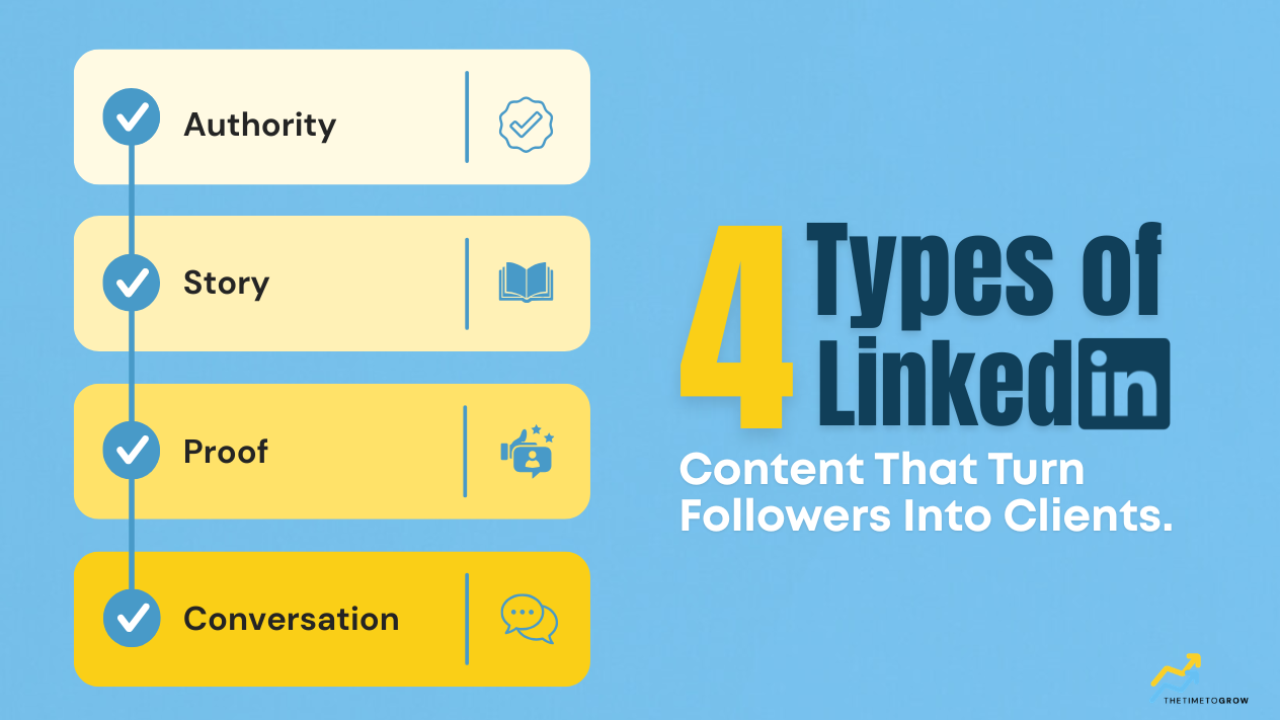
Let us start with the thing nobody tells you. Posting more on LinkedIn is not the answer. Posting the right mix is.
Most service professionals treat their feed like a diary or a billboard. One week it is all tips, the next it is all "book a call," and somewhere in there the audience quietly stops paying attention. The fix is not working harder. It is building a simple, repeatable system of LinkedIn content for service professionals that does four jobs at once: teaches, connects, proves, and invites.
That matters more than ever, because LinkedIn has quietly become the room where buying decisions get made. Four out of five LinkedIn members influence business decisions at their company, according to LinkedIn's own data shared by Sprout Social. These are not bystanders. They are the people who can say yes to hiring you.
In this post, we will walk through:
-
The 4 types of content every service professional needs in their rotation
-
What each type is actually for (and the formats that work best in 2026)
-
The monthly mix that quietly moves people from "nice post" to "let's talk"
-
A simple weekly plan you can copy
By the end, you will have a content system, not a guessing game.
Why a content mix beats posting more
Here is the data point that should change how you plan your week. LinkedIn's algorithm now rewards quality and depth over raw volume, and one strong post a week consistently outperforms five forgettable ones, according to Dataslayer's 2026 algorithm analysis. So this is not about flooding the feed. It is about balance.
A good content mix works because each post type does a different job in the relationship:
-
Some posts earn attention. They teach something useful.
-
Some posts earn trust. They show the human behind the service.
-
Some posts earn belief. They prove you get results.
-
Some posts earn a reply. They open a conversation.
Skip any one of these and the system leaks. All teaching and no proof, and you look smart but unhireable. All proof and no teaching, and you look like a walking testimonial reel. The mix is the magic.
It also helps to know that buyers are doing their homework before they ever message you. Research featured by SalesSo found that 55% of decision-makers use thought leadership content to vet the organizations they are considering, and 75% say strong thought leadership prompted them to look at a product or service they had not previously considered. Your feed is the sales call that happens before the sales call.
The 4 types of LinkedIn content every service professional needs
1. Authority content (teaches and earns the follow)
This is your heaviest-hitting category, and the one most service pros under-use. Authority content gives away real value: a framework, a teardown, a step-by-step, a "here is exactly how I would do this."
Why it works: people do not want to be sold on LinkedIn, they want to be helped. When Sprout Social looked at what users want from brands on the platform, educational content topped the list, with roughly a quarter of users specifically asking for it. Teaching is the price of attention.
Best formats for authority content:
-
Document and carousel posts. These are the highest-performing format on LinkedIn right now, with native document posts hitting around a 7% engagement rate per Socialinsider's 2026 analysis of 1.3 million posts. They also pull the highest click-through rates of any format. If you make one thing this month, make a carousel.
-
How-to text posts that break one idea into a clear, skimmable list.
-
Teardowns, like reviewing a weak profile headline and showing the stronger version.
Authority content is also your best on-ramp to an offer, because it lets you say, "We walk through how to actually build this in our workshop," without it feeling like a pitch.
2. Personal and story content (humanizes and earns trust)
People hire people. Story content is where your audience meets the human running the business, the lesson you learned the hard way, the belief that shapes how you work, the moment you almost quit and what you did instead.
This is not oversharing. It is choosing one true story and connecting it to one idea your client cares about. Personal profiles outperform company pages by roughly 8x on engagement, according to DigitalApplied's 2026 data, and a big reason is that a real voice cuts through a feed full of corporate sameness.
Best formats for story content:
-
Short narrative text posts with a strong first line.
-
Behind-the-scenes looks at how you actually do the work.
-
"What I believe about [your field]" posts that take a clear position.
A note on first lines... LinkedIn only shows the first sentence or two before the "see more" cut. Front-load the hook. The first 50 words decide whether the rest gets read.
3. Proof content (shows results and earns belief)
Teaching builds interest. Proof closes the gap between "this person seems smart" and "this person can help me." Proof content shows the outcome: a client win, a before-and-after, a mini case study, a screenshot of a kind note from someone you helped.
This is the category service professionals skip out of modesty, and it costs them clients. You do not have to brag. You just have to show the work and let the result speak. Authority and proof together also protect your pricing... 60% of decision-makers say they are willing to pay a premium to providers who demonstrate strong thought leadership, per the research summarized by SalesSo.
Best formats for proof content:
-
Mini case studies: the problem, what you did, the result.
-
Client wins and testimonials, shared with permission and context.
-
"Here is what changed" posts that pair a result with the method behind it.
The trick is to attach a lesson to every proof post, so it teaches and persuades at the same time.
4. Conversation content (sparks replies and earns reach)
The fourth type exists to do one thing: get your audience talking. Comments and replies tell the algorithm your content is worth showing to more people, and they turn a one-way broadcast into an actual relationship.
Best formats for conversation content:
-
Polls. Fast to make, easy to answer, and they hand you instant audience research.
-
Open questions tied to a real tension your clients feel.
-
"Hot take" posts that invite a friendly debate.
Conversation content is also your listening tool. The poll you run this week becomes the authority post you write next week, because now you know exactly what your audience is stuck on.
The newsletter: your fifth gear
The four types above are your weekly rotation. A LinkedIn newsletter is the engine that compounds them.
Here is why it matters so much. Regular posts reach only about 5% to 7% of your followers, but newsletters bypass the feed entirely and trigger a notification by email, push, and in-app alert every time you publish, according to Moburst's 2026 newsletter guide. That is near-guaranteed delivery to people who raised their hand and asked to hear from you. Newsletter articles also get indexed by Google, so they keep working long after a post disappears.
A newsletter is simply your best authority and proof content, gathered into a recurring piece your future clients can subscribe to. It is how a follower becomes a reader, and a reader becomes a lead.
The monthly mix that turns followers into clients
Now the part you came for. Here is a simple, repeatable monthly mix for LinkedIn content for service professionals, built around posting four to five times a week (the sweet spot for individual profiles, per Dataslayer and connectsafely benchmarks).
Across the month, aim for roughly:
-
40% Authority ... teach, give value, demonstrate the work
-
25% Story ... humanize and build trust
-
20% Proof ... show results and outcomes
-
15% Conversation ... polls, questions, replies
Then publish one newsletter per month at minimum (weekly if you can manage it, since top newsletters publish weekly).
Here is what a single week can look like:
-
Monday, Authority: a carousel breaking down a framework or checklist.
-
Tuesday, Conversation: a poll asking your audience to pick the thing they struggle with most.
-
Wednesday, Story: a short post about a lesson you learned doing the work.
-
Thursday, Proof: a mini case study with the result and the method.
-
Friday, Authority: a quick how-to text post that answers one common question.
Repeat that rhythm for four weeks and you will have a balanced, client-getting feed without reinventing your strategy every Sunday night. The point is not perfection. It is consistency, because the algorithm and your audience both reward showing up in a recognizable pattern.
Turning followers into clients on LinkedIn is not about volume or luck. It is about a mix that does four jobs:
-
Authority earns attention by teaching.
-
Story earns trust by being human.
-
Proof earns belief by showing results.
-
Conversation earns reach by sparking replies.
Wrap a newsletter around all of it, hold a steady weekly rhythm, and you build the kind of presence that buyers quietly check before they ever reach out... because they are checking, and the data says so.
You do not need to post more. You need to post in balance.
Knowing the mix is one thing. Building it into a busy week is another. That is exactly what we walk through in our free 3-day LinkedIn workshop, July 27 to 29 at 12 PM EST, where we show you how to turn posts, polls, and newsletters into clients. Save your seat here: Clients on Command Workshop: Your LinkedIn Content Roadmap
